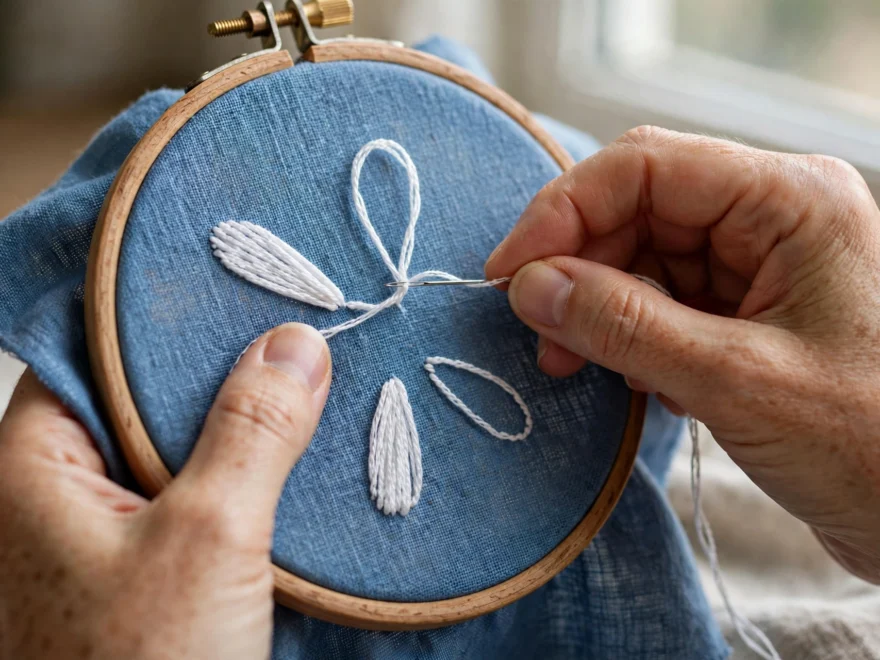
The first time I needed the lazy daisy stitch, it was 9:40 p.m. and I had promised my sister a hand-embroidered tote bag for her baby shower the next morning. The bag was plain canvas, the plan was daisies, and the problem was that I had never stitched a daisy in my life. I watched one shaky tutorial video, stabbed my way through six petals, and by 10:15 the bag had flowers on it. Wonky ones, but flowers. That is the whole pitch for the lazy daisy stitch: it is the fastest flower in embroidery, it forgives beginners completely, and five honest minutes of practice genuinely gets you there.
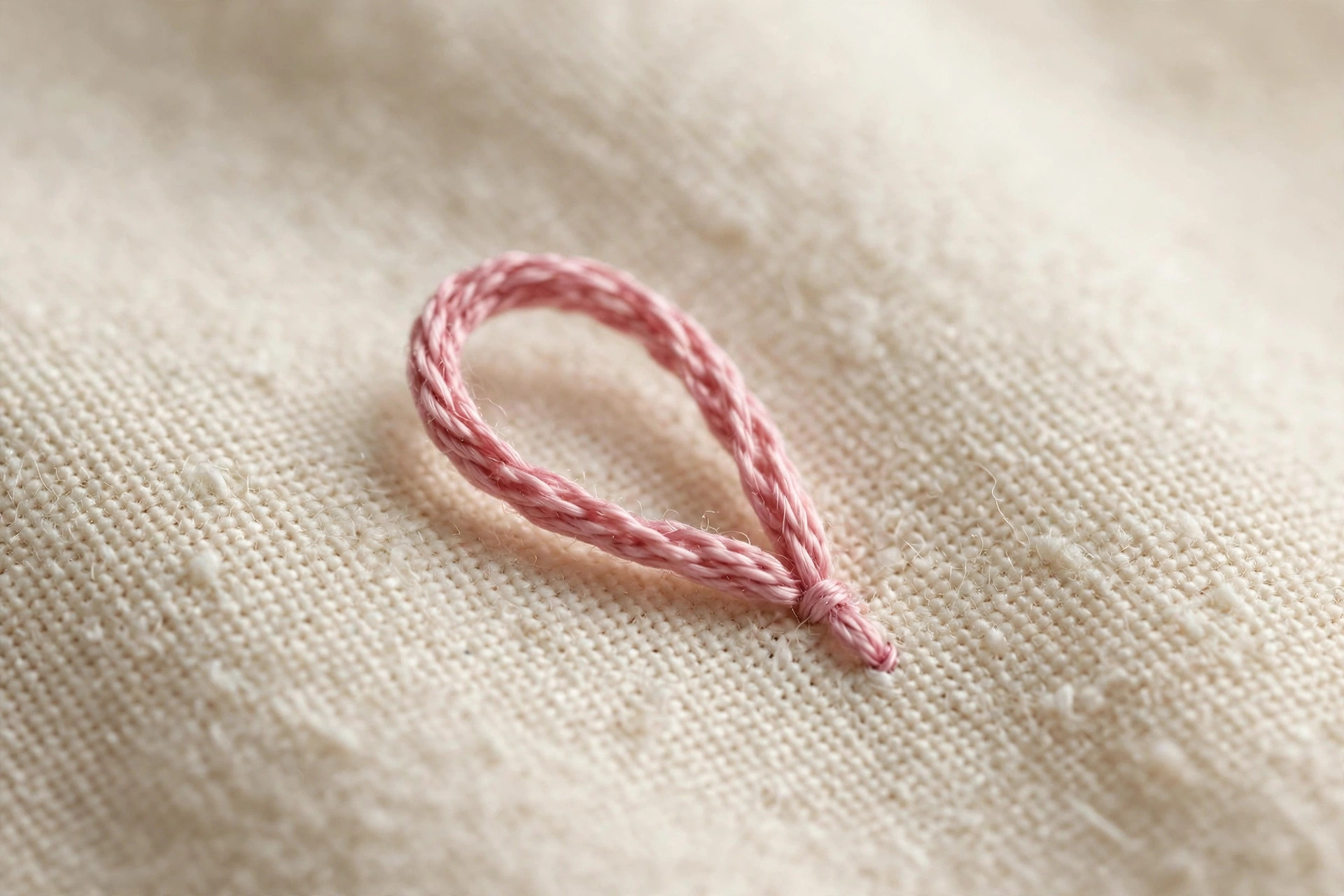
Technically it is a detached chain stitch, which is a grand name for a single chain link worked on its own instead of in a row. You make one loop, tack it down, and that loop is a petal. Older pattern books call it “detached chain,” so if a vintage design tells you to work detached chain stitch, it means this one. It belongs to the chain stitch family, and it is the friendliest member by a mile.
Thread, needle, and fabric choices
Before the first loop, get the setup right, because the lazy daisy stitch punishes bad pairings more than most beginner stitches. Two strands of DMC floss is the sweet spot for petals under an inch wide. Six strands at that scale makes a chunky petal that looks like a rope coiled on your fabric, and one strand disappears entirely. For petals over an inch, go up to three or four strands.
Needle matters more than people expect. A crewel needle with a long eye slides through the loop without snagging it, which is exactly what you want when the loop is the whole stitch. My needle and fabric guide has the size chart, but the short version is sizes 5 to 7 for two strands on quilting cotton or midweight linen. And hoop the fabric drum-tight. A slack hoop lets the loop sink and deform, and my four-direction pull method takes ninety seconds and fixes it.
The five moves, in order
1. Come up at the petal base
Bring the needle up through the fabric at the inner end of the petal, the point nearest the flower center. Every petal starts here, and keeping that start point consistent is what makes the flower look intentional instead of accidental.
2. Go back down the same hole
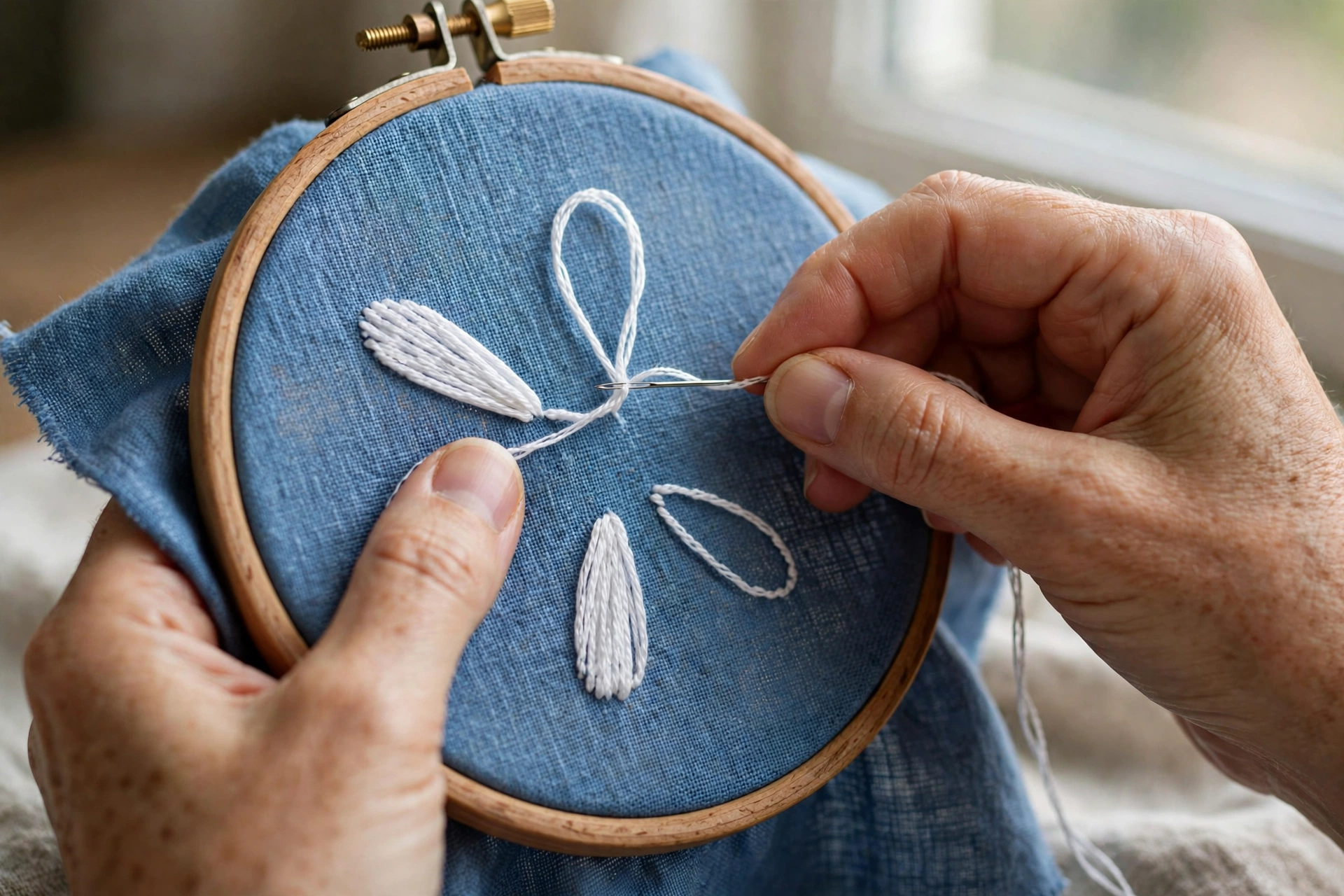
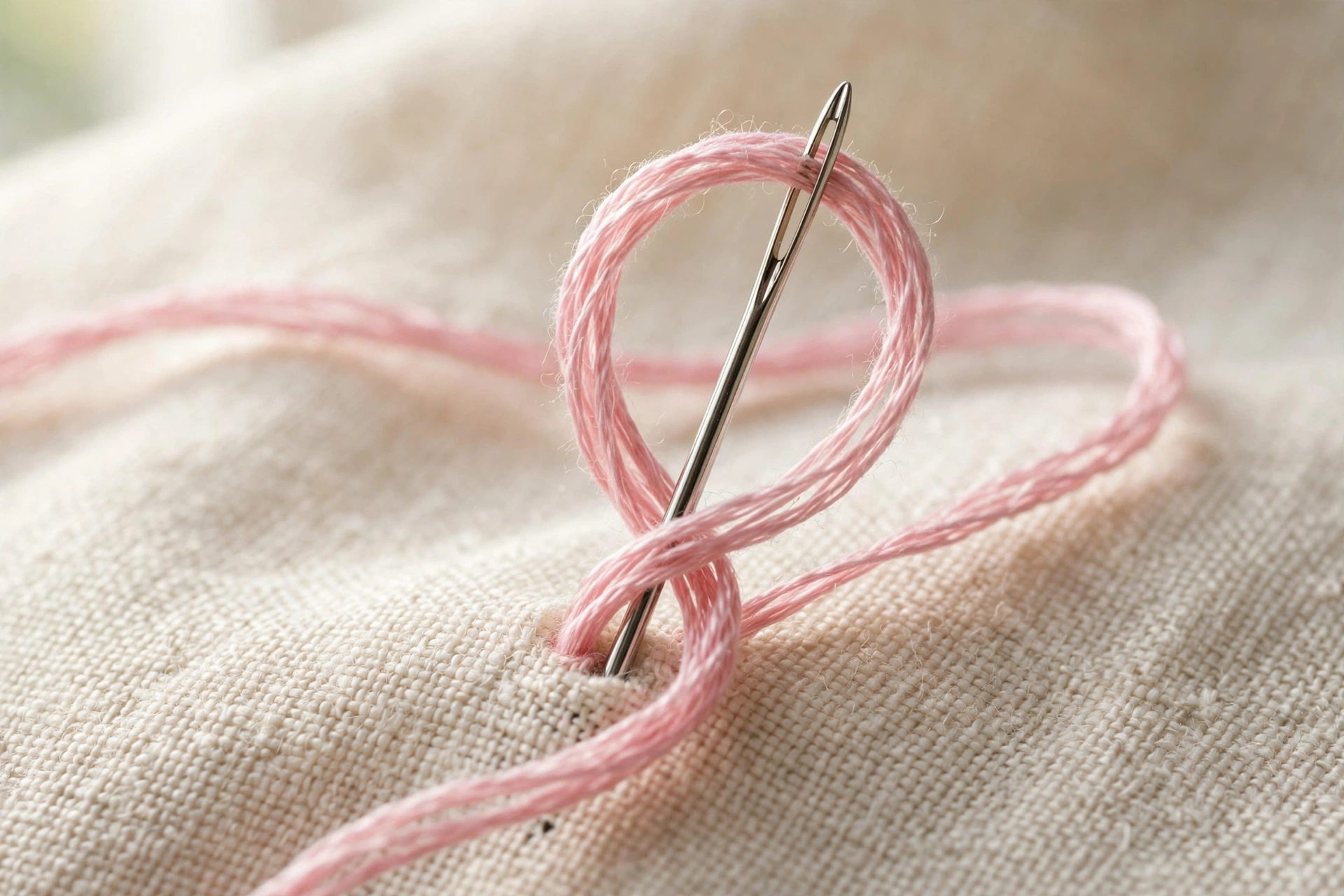
Push the needle down through the exact hole you came up through, but stop before the thread disappears. Leave a loop of thread sitting on the surface, roughly petal-sized. This feels wrong the first time. Every beginner hesitates here. It is right.
3. Come up at the petal tip
Bring the needle up at the outer end of the petal, inside the loop. The loop should be draped around your needle like a lasso. If the loop twisted, straighten it with the needle tip before you go further. A twisted loop tacks down as a twisted petal, and you will see it forever.
4. Tack the loop down
Ease the loop into a neat petal shape, then take the needle down just outside the loop, a millimeter past the tip. This tiny anchoring stitch is the entire stitch. Skip it and the loop is a mess waiting to happen. I have watched people try to hold the loop with a thumb while starting the next petal. The loop migrates, the daisy leans, sadness follows.
5. Work around the circle
Repeat, spacing the petals evenly. Six petals is the classic daisy. If your spacing drifts the way mine did for a solid month, dot the petal positions with a water-soluble pen first. Dots, not guesses.
Petal math: how many, how long
Six or seven petals reads as “daisy” to the human eye. Five reads as a generic flower. Three reads as a bud or a clover-ish accent. Eight or more starts looking like a sun, which is fine if you wanted a sun. Length is a style call: short fat loops look like cartoon daisies, long narrow ones look like the wildflowers on a seed packet. I keep a scrap of linen in my notions pouch for testing petal proportions before committing to the real piece, because frogging six tacked loops is nobody’s idea of fun.
One more variable people forget: the angle of the tack. Tack straight out from the tip and the petal lies flat and symmetrical. Tack slightly to one side and the petal curves, which looks more natural on wildflower-style designs. Tiny choice, visible difference.
The center makes or breaks it
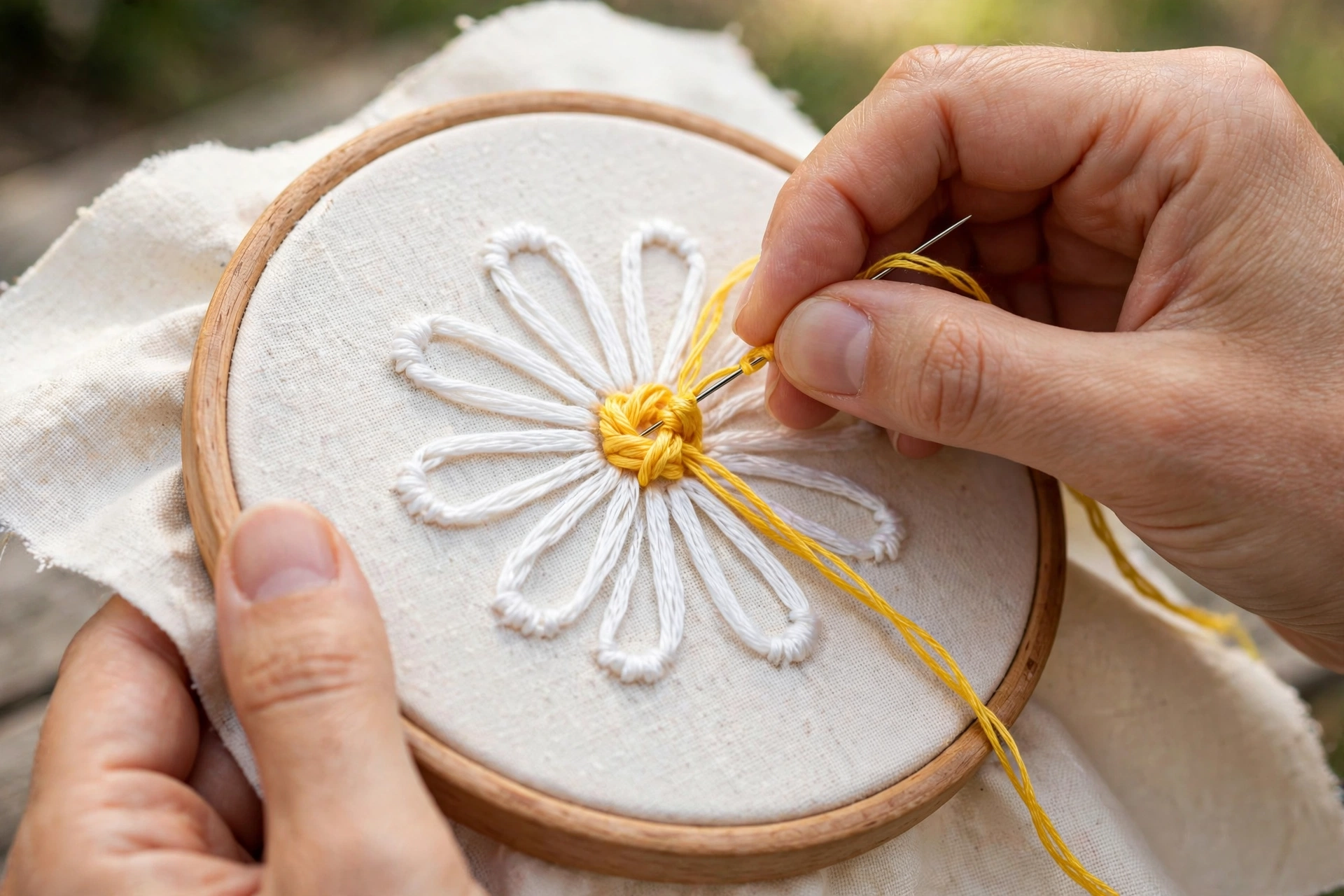
A ring of petals with an empty middle looks like a donut nobody glazed. The classic center is a French knot, or three of them clustered tight. DMC 726 yellow is the daisy default for a reason: it reads as “flower center” from across the room. If French knots still make you sweat, my French knot tutorial covers the wrap count that finally made them click for me.
Centers that also work: a small satin stitch disc, a cluster of seed stitches, or a colonial knot if you are feeling fancy. What does not work is leaving it empty or filling it with a color that fights the petals. The center should be darker or warmer than the petals, always. Light petals, dark center. That contrast is what the eye expects from a real flower.
Three variations worth learning
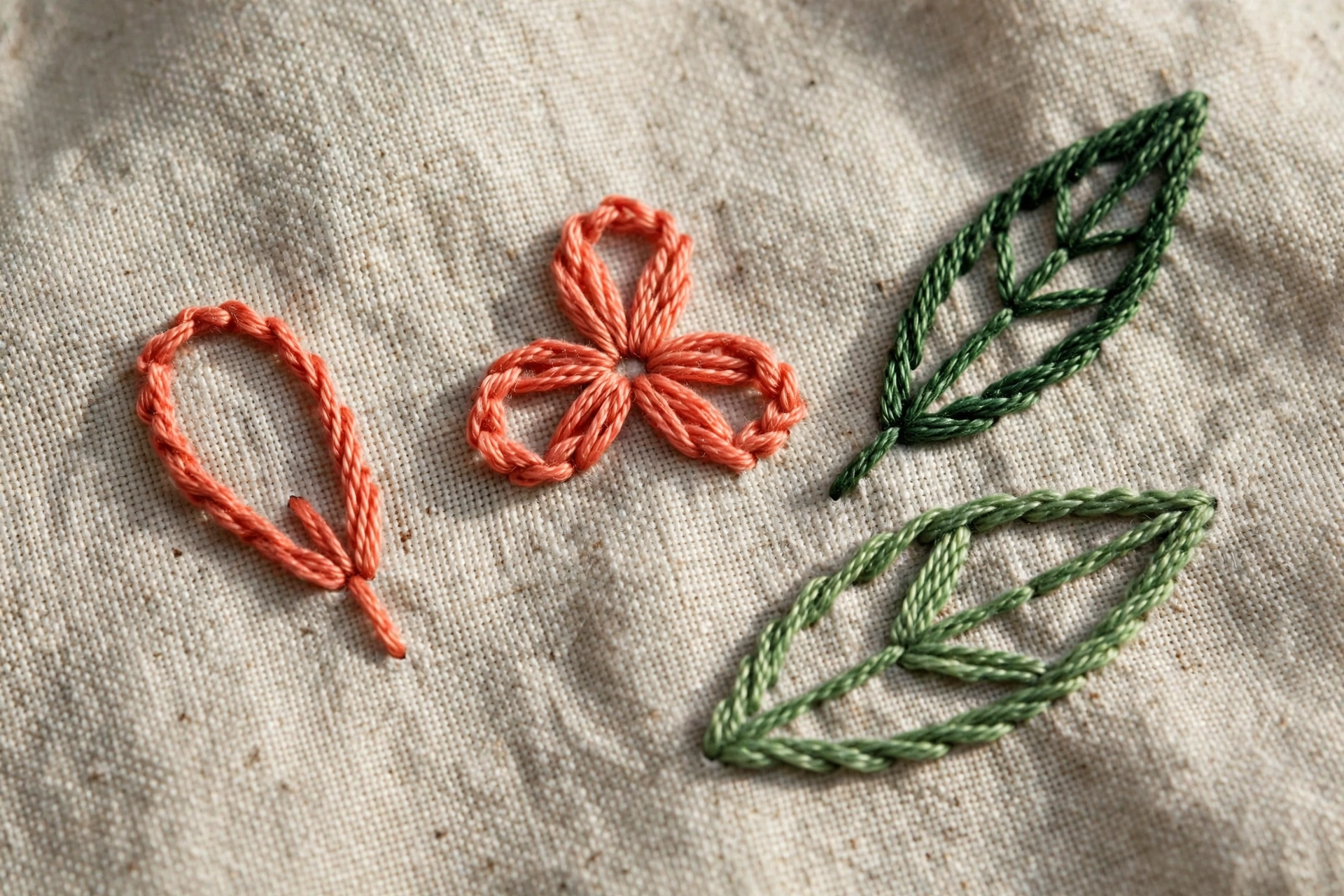
Leaves. Work the loop long and narrow, two or three along a stem, and you have leaves with no new stitch to learn. Green DMC 3345 or 3346, two strands, and they look like they belong on a botanical print.
Layered petals. Stitch a ring of long petals, then a shorter ring on top, offset so the top petals sit in the gaps. Instant depth, and it hides every sin in the first layer. This is the trick behind those lush-looking flowers that seem far more advanced than they are.
Scattered filling. Toss single loops inside an outlined shape and tack each one down. It fills space faster than satin stitch and looks deliberately textured rather than lazy, despite the name. I filled an entire watering can silhouette this way once and got asked if it was a “special technique.” It was laziness, elevated.
Mistakes that make daisies look drunk
Yanking the loop tight. The number one beginner error, and I did it for weeks. A strangled loop becomes a thin sliver instead of a petal. Ease it into shape with the needle tip, then tack. The thread should lie relaxed on the fabric, not dug into it.
Uneven loop sizes. Your first daisy will have one petal the size of a canoe and one the size of a grain of rice. The pen dots fix this. So does practice. So does accepting that handmade flowers are allowed to be a little irregular, which is the whole point of handmade.
Too many strands. Six strands makes a great bold petal at large scale and a ridiculous rope at small scale. Under half an inch, drop to two strands. My floss vs thread guide covers the strand math if you have never thought about it.
Stitching on slack fabric. Worth repeating because it ruins more lazy daisies than any technique error. The loop needs a firm surface to sit on. If your hoop loosens mid-flower, stop and re-seat it. Ninety seconds now beats frogging later.
What to stitch first
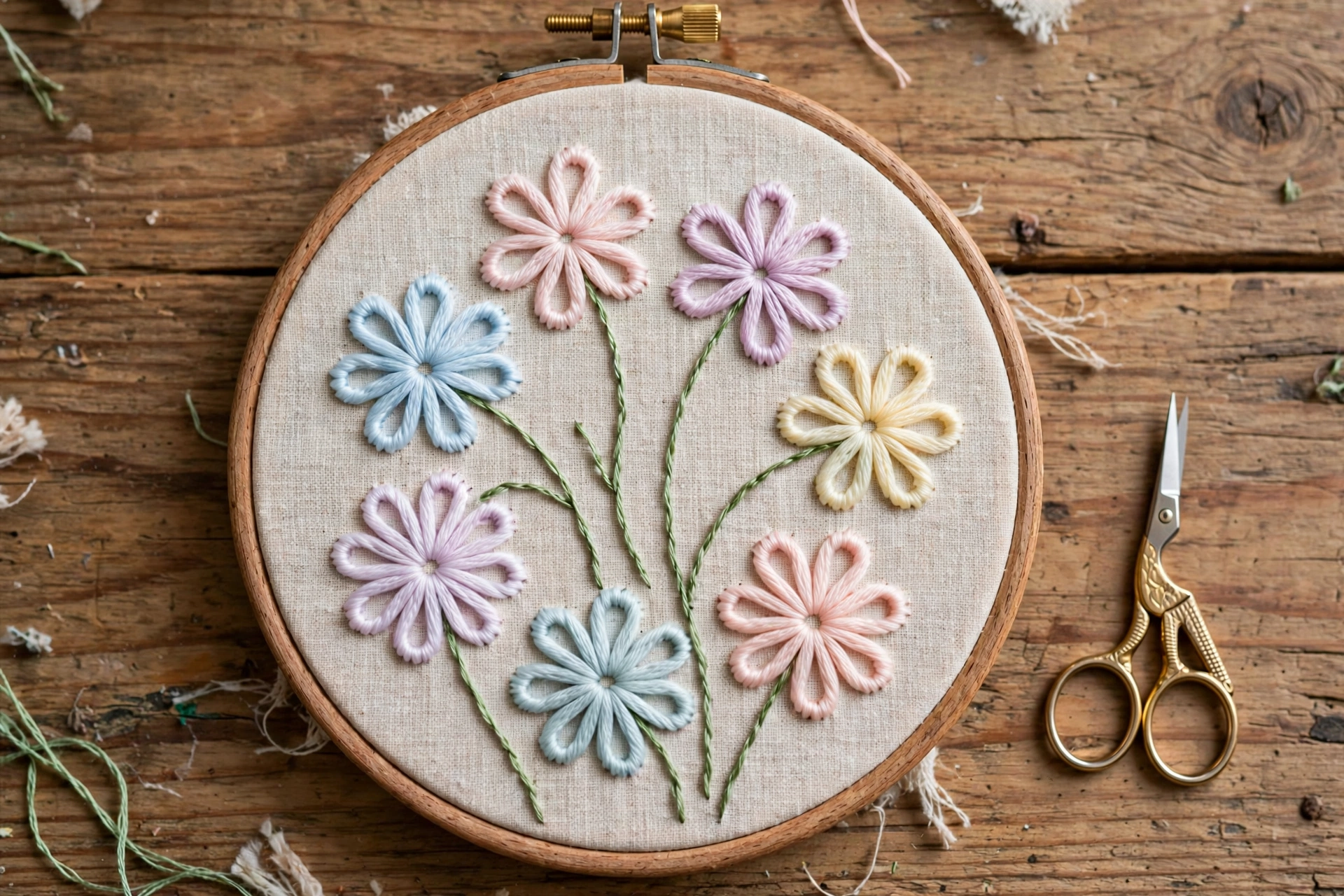
Three starter projects, in order of bravery required. A single daisy on a linen napkin corner, six petals and a French knot, takes fifteen minutes and teaches you spacing. A row of three-petal buds along a tote bag strap teaches you consistency, because the third bud will expose every bad habit the first two hid. And a full seven-flower hoop, stems in stem stitch, is a genuinely giftable finished piece that uses exactly two stitches. Mine went to my sister a year late. She pretended not to notice.
That is the whole stitch. Five minutes to learn, and it never gets boring because half the flowers you will ever meet are variations on it. Once your petals sit evenly, the skill that levels up everything is making each stitch land the same size. Go put daisies on something.