Every March I get the same itch. The light changes, the first brave crocus pushes through the mulch, and suddenly my winter palette of deep reds and forest greens feels completely wrong. I want pastels. I want flowers. I want to stitch something that smells like rain and looks like morning. Spring embroidery ideas are not just seasonal decoration, they are a mood reset in thread form, and after the gray months, that reset matters.
Spring stitching has its own logic. The motifs are specific: the flowers that actually bloom in spring, the creatures that return, the colors of new growth. The palette shifts lighter and brighter. And the projects tend toward the fresh and functional, because spring is when we open windows, set tables outside, and want our homes to feel like the season. Here are fifteen spring motifs with stitch guidance, three spring palettes with exact DMC numbers, and project ideas that carry the season into every room. For more plant and leaf designs to pair with the flowers, my botanical embroidery patterns collection is a good companion.
The spring palette: three color stories
Spring colors are about light. After winter’s saturation, spring wants pastels, fresh greens, and clear yellows. Here are three palettes I return to every year, with the DMC numbers so you can buy exactly the right skeins.
Palette 1: Orchard Blossom. The pink-and-white palette of flowering trees. DMC 602 (medium pink), DMC 605 (light pink), DMC 951 (pale blush), DMC 3348 (light spring green), DMC 935 (dark avocado green for depth). This palette is romantic without being saccharine, and it works for everything from cherry blossoms to wild roses. I stitched an entire spring wreath in these five colors last April and it is still my favorite seasonal piece.
Palette 2: Daffodil Morning. The yellow-and-green palette of the first real flowers. DMC 727 (pale yellow), DMC 783 (golden yellow), DMC 581 (moss green), DMC 3347 (yellow-green), DMC white for accents. Yellow is tricky in embroidery because it can look washed out, so the trick is contrast: pair the yellows with strong greens and let the green do the framing. Daffodils stitched in 727 with 783 centers on a green stem practically glow.
Palette 3: Rain Garden. The blue-and-green palette of spring showers. DMC 827 (pale blue), DMC 3761 (sky blue), DMC 501 (dark blue-green), DMC 3346 (hunter green), DMC 168 (silver gray for rain details). This is the sophisticated spring palette, less obvious than the pinks and yellows, and it is stunning for rain-themed pieces: umbrellas, raindrops, bluebells, and the particular gray-green of wet leaves.
Fifteen spring motifs with stitch guides
Each motif includes the stitches that render it best and the approximate size. All of them fit in a 4-inch hoop or smaller, because spring projects should feel light, not laborious.
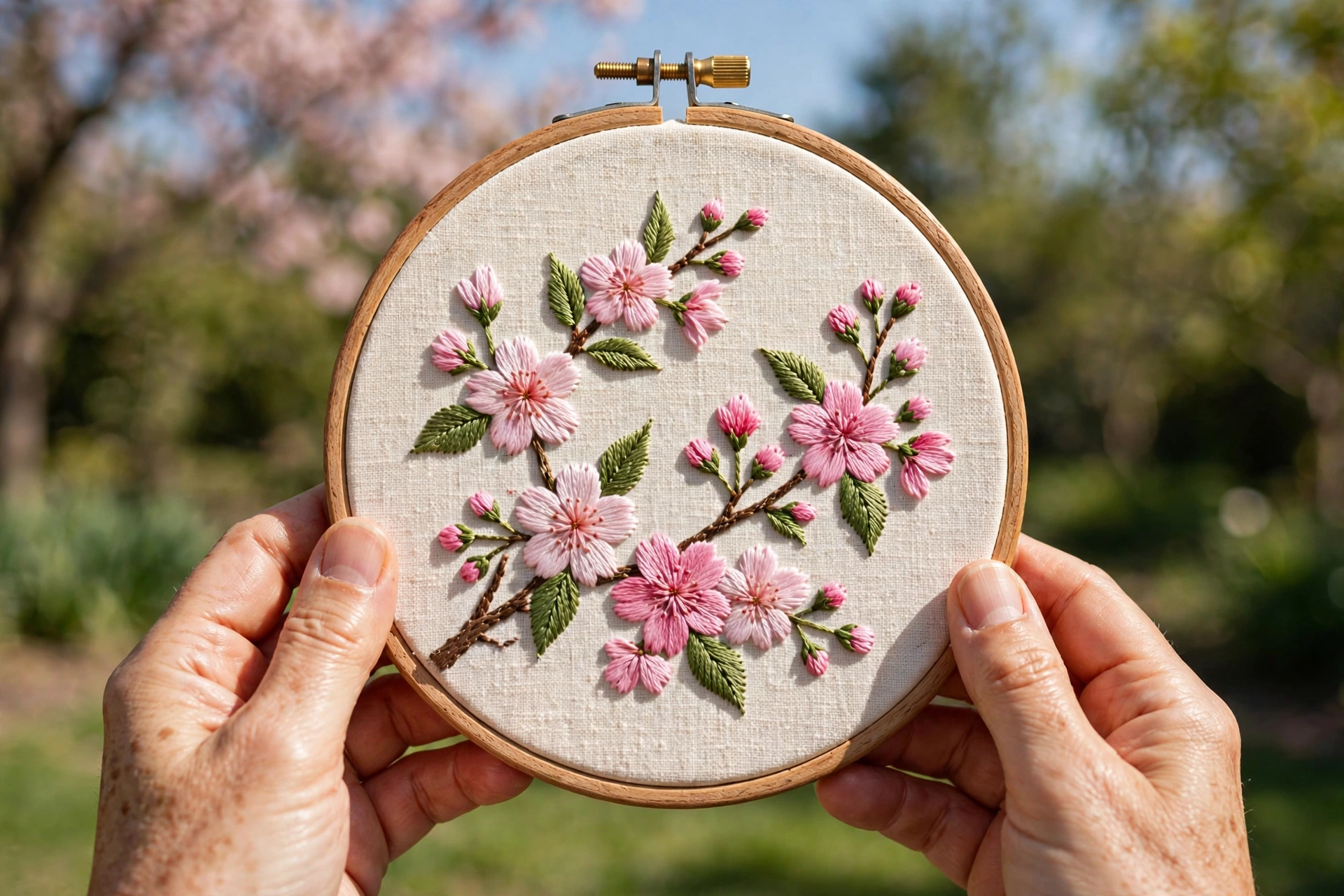
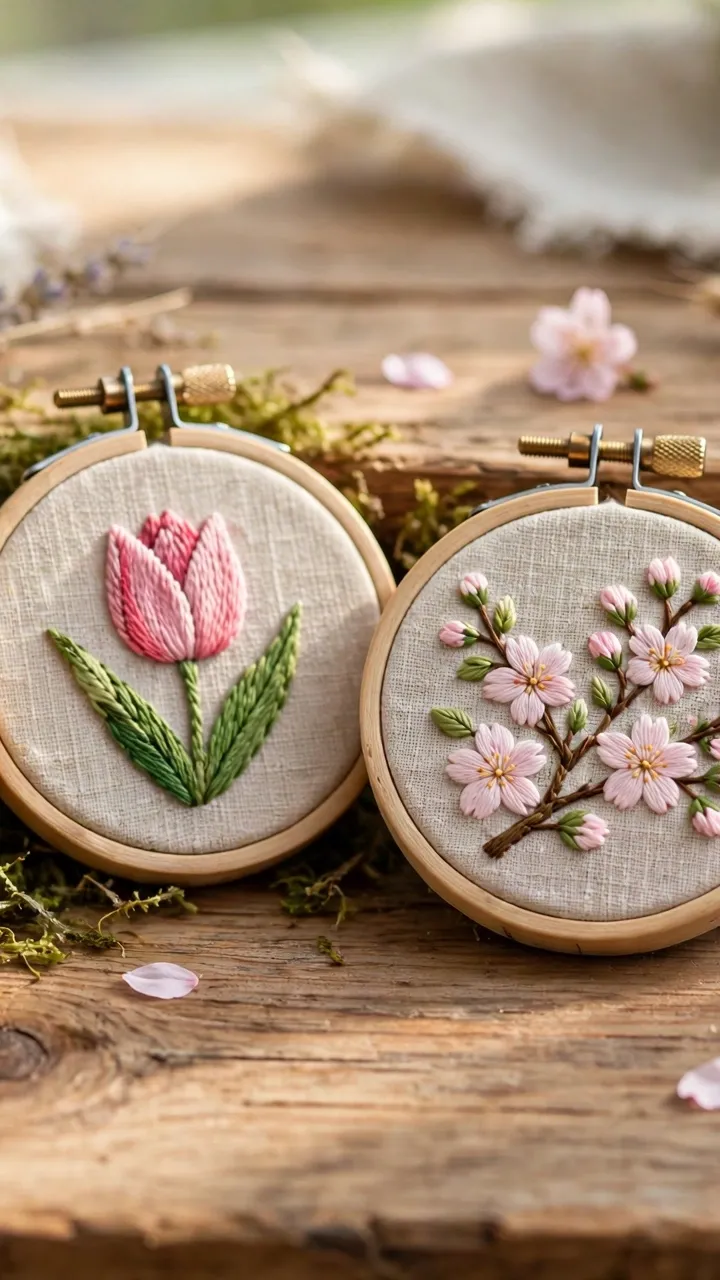
1. Cherry blossom branch. Stem stitch branch in brown, five-petal blossoms in lazy daisy using DMC 605, French knot centers in DMC 783. The classic spring motif for a reason. Keep the blossoms clustered at the branch tips the way real cherry blossoms grow, not evenly spaced like wallpaper.
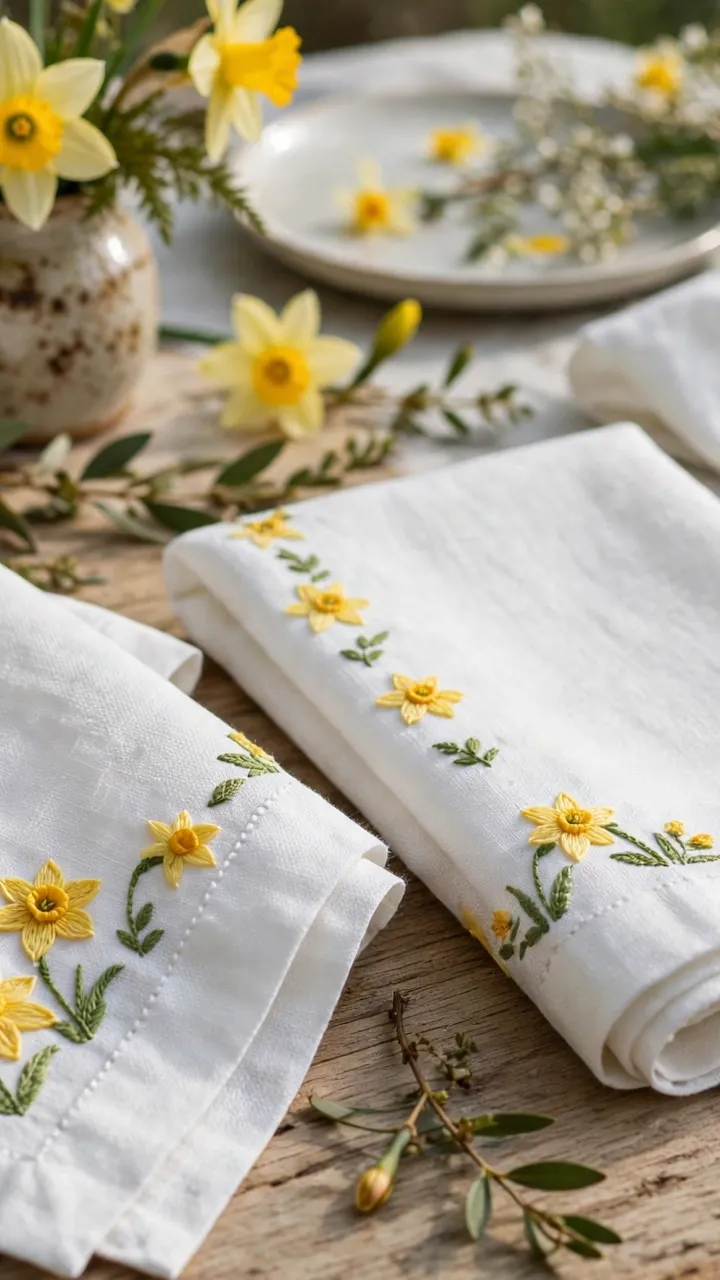
2. Daffodil. Six pointed petals in long straight stitches using DMC 727, trumpet center in satin stitch with DMC 783, stem in stem stitch. Daffodils are geometrically simple, which makes them perfect for beginners. The trumpet is just a small satin-stitched cup. Do not overthink it.
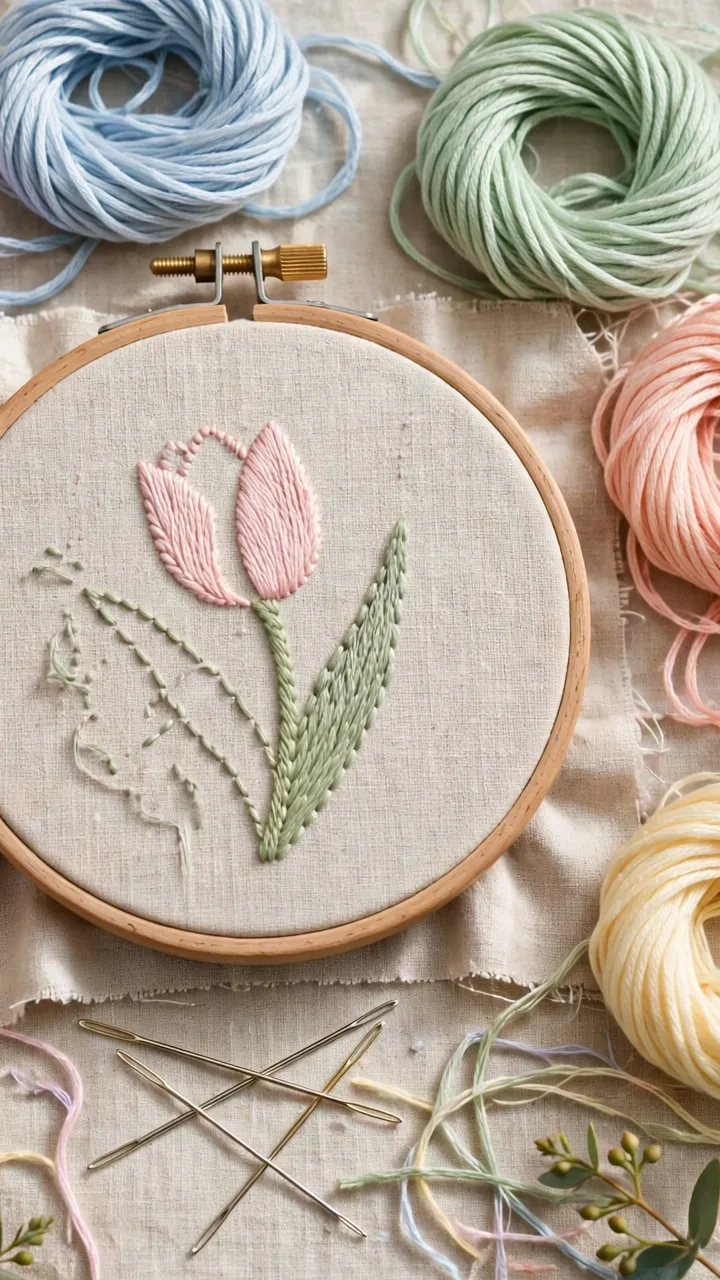
3. Tulip. Three overlapping petals in satin stitch, DMC 602 or 606, with a stem and two long leaves in stem stitch. Tulips teach the most important satin stitch lesson: overlap the petals slightly so there are no gaps. A tulip with gaps looks like a tulip with problems.
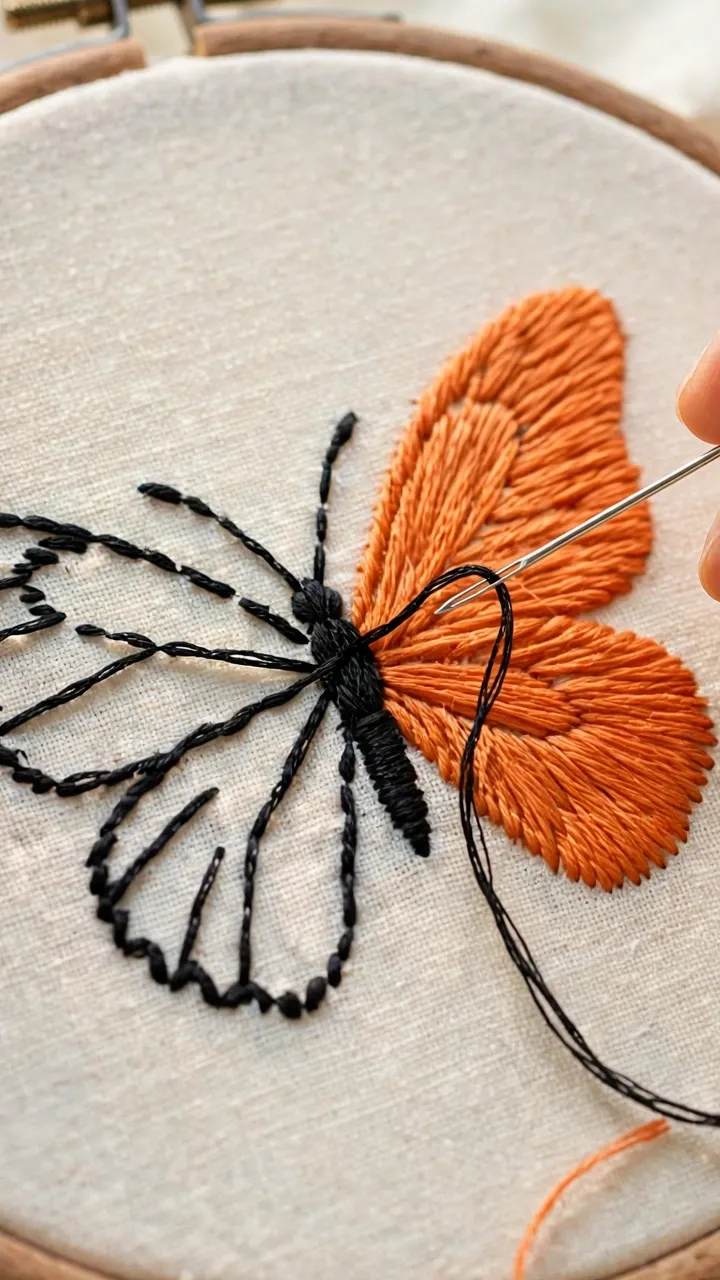
4. Butterfly. Upper wings in satin stitch, lower wings in smaller satin stitch, body in stem stitch, antennae in straight stitch with French knot tips. Butterflies are the ideal dimensional project because the wings can be slightly padded for a 3D effect. Use two contrasting colors, orange and black is classic, but dusty pink and sage is very spring.
5. Rain cloud. Cloud outline in backstitch or stem stitch in gray, raindrops in straight stitch in blue below it. Whimsical, simple, and perfect for a nursery or a rain-lover’s wall. Add a tiny sun peeking out for the “April showers” narrative.
6. Bird on a branch. Body in satin stitch or long-and-short, wing in a contrasting color, legs in straight stitch, eye in a single French knot. Birds are easier than they look because the body is basically an oval. The French knot eye is what makes it come alive. Without the eye it is a potato. With the eye it is a bird.
7. Lily of the valley. Arching stem in stem stitch, tiny bell flowers in lazy daisy stitch in white, small green leaves. Delicate and old-fashioned in the best way. This is a Mother’s Day classic, and the white-on-cream version is breathtakingly subtle.
8. Sprouting seedling. Two small leaves in lazy daisy, a curved stem, three French knot soil dots below. The simplest motif on this list and one of the most charming. It says “new beginnings” without saying a word, which makes it perfect for graduations, new jobs, and new homes.
9. Umbrella. Canopy in satin stitch panels of alternating colors, handle in stem stitch with a curved hook. Umbrellas are fun because the panel structure gives you natural color-blocking. Do each panel in a different spring pastel and it looks like a design choice instead of indecision.
10. Frog. Body in satin stitch green, eyes as French knots on top, smile in stem stitch. Frogs are supposed to be a little goofy, which takes all the pressure off. A slightly lopsided frog is a charming frog. This is the motif I recommend to anyone who says they “cannot draw,” because frogs forgive everything.
11. Wisteria spray. Hanging clusters of small lazy daisy flowers in purples and pinks, DMC 554 and 605, on a stem stitch vine. Wisteria teaches cluster composition: start dense at the top and thin out toward the bottom, the way real wisteria hangs. Stunning on a tall narrow hoop.
12. Robin’s nest. Nest in woven straight stitches in brown, three small eggs in satin stitch blue with French knot speckles. The nest is just crisscrossed straight stitches, messy on purpose. The eggs are where the precision goes. This contrast of rough and smooth is what makes it work.
13. Dandelion clock. Thin stem in stem stitch, seed head as radiating straight stitches in white or pale gray with tiny French knots at the tips. Ethereal and nostalgic. Work it on a dark background for maximum drama, because white stitches on navy linen look like actual magic.
14. Watering can with flowers. Can outline in backstitch, water drops in straight stitch blue, flowers spilling out in lazy daisy. This is a story in a hoop: the can, the water, the blooms. It takes about four hours and it makes everyone smile.
15. “Hello spring” lettering. The words in stem stitch or backstitch, surrounded by small spring motifs from this list. Lettered pieces are the ultimate seasonal decor because they say exactly what they mean. Keep the lettering simple and let the motifs do the decorating.
Spring projects: from quick to ambitious
Afternoon: spring napkin corners. One daffodil or tulip on the corner of each napkin in a set of four. Two hours per napkin. Spring table linens get used for every meal from Easter through June, which is an excellent return on eight hours of stitching.
Weekend: the spring wreath hoop. A 6-inch hoop with a full circle of mixed spring flowers from the motif list above. Six to seven hours. Hang it on the front door the way other people hang store-bought wreaths, except yours will still be beautiful in July.
Long weekend: the spring table runner. A vine of spring flowers down the center of a linen runner. Twelve to fifteen hours. This is the project that makes Easter dinner feel like an event, and it becomes the table’s spring uniform for years.
Ongoing: the seasonal rotation. Stitch one spring hoop per week through March and April, four to six hoops total, and rotate them with your winter pieces. By May you have a full spring collection, and the weekly rhythm keeps the stitching joyful instead of pressured.
What to avoid in spring stitching
Do not use winter-weight floss counts. Spring designs look best in 2 strands, not 3. The lighter coverage matches the season’s airiness. Three strands on a cherry blossom looks heavy and wintery no matter how pink the floss is.
Do not stitch spring flowers from memory alone. Look at a real photo of a daffodil before you stitch one. The number of petals, the shape of the trumpet, the way the leaves attach, these details are what separate a flower that reads as “daffodil” from one that reads as “yellow thing.” Thirty seconds with a reference photo saves thirty minutes of frogging.
Do not forget the background. Spring pieces glow on the right fabric. White and cream linen make pastels pop. Pale blue linen makes whites luminous. Avoid dark backgrounds for spring florals unless you are deliberately going for drama, because dark fabric visually weighs down designs that should feel light.
Storing spring pieces when the season ends
Seasonal stitching gets stored for eight months of the year, so store it right. Clean hoops with a soft dry brush, never water, before putting them away. Wrap each piece in acid-free tissue, not plastic, because plastic traps moisture. Store flat or hung, never folded, because fold lines in linen are permanent and fold lines through stitching are heartbreaking. Label the storage box by season. Future-you, digging through the attic in March, will be grateful.
Spring is the season that reminds us why we stitch: for the pleasure of making something beautiful with our hands, at the pace of the growing things outside. Pick one motif from the list, the cherry blossom if you want classic, the frog if you want fun, and stitch it this weekend. By the time the petals fall outside, you will have your own blossoms that never fade.